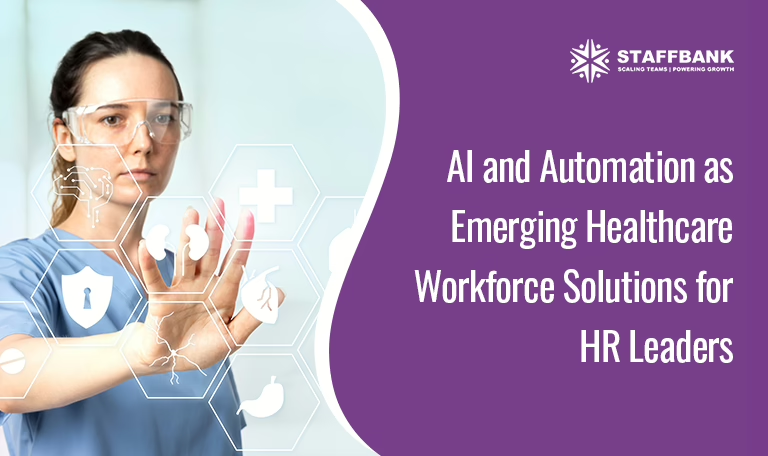
AI and Automation as Emerging Healthcare Workforce Solutions for HR Leaders
The pressure on healthcare HR leaders has never been greater. Vacancy rates are climbing, burnout is accelerating attrition, administrative workloads are consuming clinical time, and the competition for qualified talent is increasingly global. Against this backdrop, artificial intelligence and automation are no longer experimental technologies confined to pilot programmes, they have become operational necessities reshaping how healthcare organisations find, deploy, and retain their people.
For HR leaders navigating this environment, understanding where AI genuinely delivers and where human judgement remains irreplaceable is the defining strategic challenge of 2026.
The Scale of the Problem AI Is Being Asked to Solve
Before examining the solutions, the context matters. The United States alone faces a projected shortfall of more than 3.2 million healthcare workers by 2026, according to workforce analysis by StaffDNA. Administrative roles are seeing annual attrition rates between 20 and 35 percent. Nearly half of hospitals report vacancy rates exceeding 10 percent. Nurses, physicians, allied health professionals, and support staff are all in short supply simultaneously, creating a compounding workforce crisis that no single hiring initiative can resolve.
At the same time, healthcare organisations are spending enormous sums on reactive solutions. Replacing a single nurse can cost between $40,000 and $60,000. Agency spend, overtime costs, and the operational drag of understaffing are eroding margins at health systems already under financial pressure. This is the environment in which AI and automation are arriving, not as luxury investments, but as structural responses to a structural problem.
Where AI Is Making a Measurable Difference
1. Recruitment and Candidate Screening
The most immediate application of AI in healthcare staffing management is at the front end of the hiring process. A 2024 McKinsey survey found that 70 percent of healthcare organisations are implementing or planning to adopt generative AI, with a significant share focused on clinician productivity and talent acquisition.
For HR teams working with or evaluating a healthcare recruitment automation company, AI-assisted screening tools are already changing the pace and precision of candidate selection. Platforms now assess clinical competencies, credential validity, and role fit simultaneously, reducing time-to-hire by as much as 45 percent in some deployments. Applicant tracking systems enhanced with AI can process thousands of CVs, flag credential gaps, and rank candidates against specific clinical requirements in a fraction of the time previously required.
Importantly, this is not about replacing human recruiters. It is about removing the volume-based administrative burden that consumes recruiter time, so that experienced professionals can focus on relationship-building, cultural fit assessment, and the nuanced conversations that determine whether a highly sought-after clinician will accept an offer.
2. Workforce Planning and Predictive Analytics
Perhaps the most strategically significant application of AI in healthcare workforce solutions is predictive planning. Historically, staffing decisions have been made reactively, filling vacancies after they appear, escalating to a AI driven healthcare staffing agency when internal resources run out. AI is beginning to shift this from reactive to proactive.
Predictive analytics tools now allow facilities to forecast patient census with meaningful accuracy up to 48 hours in advance. This enables staffing managers to align nurse-to-patient ratios with anticipated demand rather than responding to surges after they occur, reducing expensive last-minute agency spend, unnecessary overtime, and the burnout that comes from persistent short-staffing.
Over 70 percent of large healthcare groups are now using recruitment intelligence platforms to identify skill gaps, forecast attrition, and plan succession for key clinical roles. For HR leaders, this represents a shift from workforce management as an operational function to workforce strategy as a competitive capability.
3. Administrative Automation
One of the most direct contributors to clinician burnout is administrative overload. Physicians in the United States spend an average of nine hours per week on administrative tasks, with nearly half considered unnecessary red tape. Nurses face similar burdens through manual documentation, scheduling, and compliance reporting that pull their attention away from patient care.
AI-powered automation is beginning to reclaim these hours. Patient intake processes, appointment scheduling, prescription refill routing, prior authorisation follow-up, and discharge documentation are all areas where automation is already reducing the burden on clinical staff. The result is not just efficiency, it is workforce capacity. When clinicians spend fewer hours on administrative tasks, organisations can effectively serve more patients without adding headcount.
For HR leaders, the implication is significant: AI-driven workflow automation is a healthcare workforce solution in its own right, reducing the need to hire additional staff by enabling existing staff to operate at full clinical scope.
4. Credential Verification and Compliance Management
Healthcare hiring is uniquely complex from a regulatory standpoint. Every clinician must hold valid licensure, meet continuing education requirements, pass background checks, and comply with credentialing standards specific to their role and setting. For a healthcare recruitment agency sourcing candidates across multiple states or internationally, managing this compliance burden manually creates bottlenecks that delay placements and expose both the agency and the hiring facility to risk.
AI-enabled credentialing platforms are automating primary source verification, flagging expiring licences, tracking CME compliance, and ensuring documentation is complete before a candidate is presented for placement. This reduces credentialing delays that can otherwise push time-to-fill from days into weeks, and gives HR leaders confidence that every placed clinician meets the regulatory requirements of their jurisdiction.
5. Shift Scheduling and Per Diem Optimisation
For hospitals and long-term care facilities managing large, variable clinical workforces, AI-powered scheduling represents one of the highest-ROI automation investments available. Dynamic scheduling tools can balance shift preferences, compliance constraints, fatigue management rules, and census forecasts simultaneously, producing optimised rosters that manual schedulers cannot replicate.
For healthcare staffing agencies managing per diem and contingent nursing pools, these platforms make a material difference to fill rates. When a facility knows 48 hours in advance that it will need two additional ICU nurses on a Wednesday night, an agency with strong scheduling technology can respond before the gap becomes a crisis. Staffing firms with effective scheduling platforms and deep local clinician pools are increasingly winning business from health systems that previously relied on last-minute reactive hiring.
What AI Cannot Replace
For all the genuine efficiency gains AI delivers, HR leaders in healthcare must be clear-eyed about its limitations, particularly in a sector where the human dimension of care is fundamental.
A 2026 SHRM report found that over half of organisations do not involve their HR function directly in AI strategy development, creating a risk that AI solutions are implemented without adequate consideration of workforce needs. In healthcare, this risk is especially acute. Candidate assessment for clinical roles requires contextual judgement that AI cannot fully replicate, understanding the culture of a unit, the leadership style of a department head, or the interpersonal dynamics that will determine whether a skilled clinician thrives or leaves within six months.
There is also the matter of candidate trust. Nurses and physicians seeking new roles want to feel valued and understood by the organisations pursuing them. An over-automated recruitment process, where candidates interact primarily with chatbots and automated screening tools, can undermine the relationship that ultimately drives offer acceptance. While AI can help find the right candidates for an opening, the human element still matters, and experienced recruiters serve as career guides in ways that technology simply cannot replicate.
The most effective healthcare workforce solutions in 2026 combine AI’s processing power with human expertise, using automation to handle volume and compliance, while keeping experienced recruiters and HR professionals at the centre of the relationships that determine long-term workforce outcomes.
Strategic Implications for HR Leaders
For HR leaders evaluating how to integrate AI and automation into their healthcare workforce strategy, several priorities stand out.
Start with administrative burden, not headcount. Before investing in additional recruitment capacity, identify which non-clinical tasks are consuming the most staff time. Automating these processes creates workforce capacity without requiring new hires, and directly addresses one of the primary drivers of burnout and attrition.
Invest in workforce planning infrastructure. Reactive hiring is expensive and destabilising. AI-powered analytics that forecast attrition, model demand scenarios, and identify skill gaps before they become vacancies are the foundation of a sustainable workforce strategy.
Choose staffing partners who use technology effectively. Whether you are working with a healthcare recruitment agency to fill specialist clinical roles or a healthcare staffing agency to manage per diem coverage, the technology capability of your staffing partner directly affects your outcomes. Agencies with AI-assisted screening, automated credentialing, and dynamic scheduling tools will consistently outperform those relying on manual processes, in speed, compliance accuracy, and the quality of candidate matching.
Keep humans at the centre of candidate relationships. Automate the transactional; invest the time saved into the conversations, mentorship, and career development that retain good people once they are hired.
Build digital fluency into your workforce planning. Hospitals and health systems are now prioritising digital fluency and AI readiness across entry-level roles, marking a major shift in workforce expectations. HR leaders who build this into their hiring criteria and onboarding today are developing a workforce better positioned to extract value from future technology investments.
The Bigger Picture
The global per diem nurse staffing market is projected to reach $13 billion by 2030. The US healthcare staffing market as a whole was valued at $45 billion in 2025 and is projected to nearly double by 2033. These figures reflect a healthcare system in which flexible, technology-enabled workforce solutions have become a permanent structural feature, not a pandemic-era anomaly.
For HR leaders, this environment demands a fundamental rethinking of what healthcare workforce solutions look like. The organisations that are gaining ground are not simply hiring more people or spending more on agency fill, they are using AI and automation to reduce the friction in every stage of the workforce lifecycle, from sourcing and credentialing to scheduling and retention.
That shift requires HR to lead, not follow. The technology is available. The partnerships, with specialist healthcare recruitment companies, technology platforms, and data providers, are accessible. What is needed is the strategic clarity to deploy them in an integrated way, and the organisational credibility to make workforce planning a board-level priority rather than an operational afterthought.
For healthcare HR leaders willing to make that commitment, AI and automation are not threats to the profession. They are the most powerful tools available to finally get ahead of a workforce crisis that has been building for decades.
Looking to strengthen your healthcare workforce strategy? A specialist healthcare recruitment agency Staffbank Outsourcing Solutions can provide not just talent pipelines but workforce intelligence, compliance expertise, and technology-enabled staffing solutions designed for the complexity of today’s clinical environment.