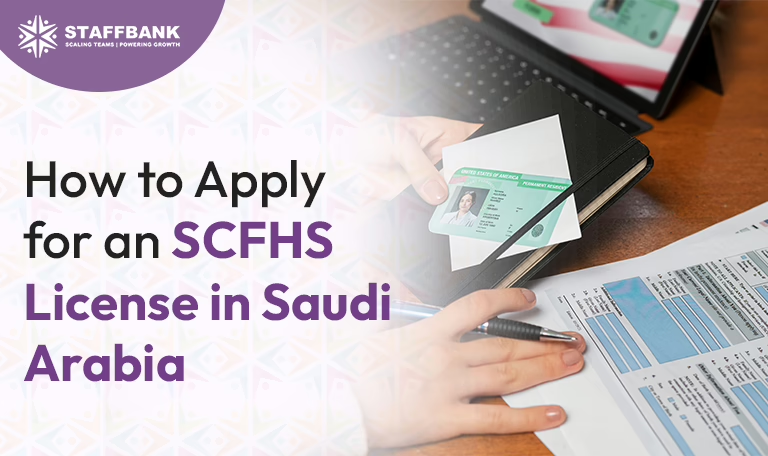
How to Apply for an SCFHS License in Saudi Arabia: The Complete 2026 Guide
Saudi Arabia’s healthcare sector is expanding faster than almost any other in the region — driven by Vision 2030, major hospital expansion programmes, and a sustained push to build specialist capacity across the Kingdom. For internationally trained doctors, nurses, and allied health professionals, that expansion means genuine opportunity.
But it also means one unavoidable step: registration with the Saudi Commission for Health Specialties (SCFHS).
For candidates unfamiliar with Gulf licensing, SCFHS registration can look like a maze of acronyms and sequential requirements. It isn’t, once you understand the order the pieces fall in. This guide sets out exactly what SCFHS licensing in Saudi Arabia involves, what it costs in time and documentation, and where candidates most commonly lose weeks they didn’t need to lose.
What Is SCFHS, and Why Does It Matter?
The Saudi Commission for Health Specialties is the regulatory body responsible for licensing and classifying healthcare professionals across Saudi Arabia. No physician, nurse, dentist, pharmacist, or allied health professional can practise legally in the Kingdom — public or private sector — without a valid SCFHS classification and registration.
SCFHS doesn’t just confirm you’re qualified. It classifies your specific level of practice — consultant, specialist, general practitioner, or registered nurse, for example — which in turn determines your scope of practice, salary banding in many institutions, and eligibility for specific roles. Getting this classification right the first time matters enormously; a misclassified application can mean reapplying at a different level months later.
Who Needs SCFHS Registration?
SCFHS registration is required for all licensed healthcare professionals seeking to practise in Saudi Arabia, including:
- Consultants and specialist physicians
- General practitioners
- Registered and specialist nurses
- Dentists
- Pharmacists
- Allied health professionals across all major disciplines
Step 1: DataFlow Primary Source Verification
Before SCFHS will assess your application, your qualifications and employment history must be independently verified through DataFlow Group — the same primary source verification process used across most Gulf healthcare regulators. DataFlow contacts your universities, licensing bodies, and former employers directly to confirm your credentials are genuine, then issues a verification report that becomes part of your SCFHS file.
Candidates applying to more than one Gulf market should note that a DataFlow report generated for a different regulator (for example, QCHP in Qatar or DHA in Dubai) cannot simply be reused for SCFHS — each destination requires its own verification report.
Step 2: SCFHS Classification Assessment
Once your DataFlow report is complete, SCFHS assesses your qualifications, postgraduate training, and clinical experience to determine your professional classification. This step is where your years of practice, board certifications, and specialist training are formally evaluated against Saudi Arabia’s classification framework.
Step 3: Prometric Examination (Where Applicable)
Many professions — including physicians, general practitioners, and several nursing and allied health categories — are required to sit and pass a Prometric examination as part of SCFHS registration. This computer-based exam tests clinical knowledge relevant to your specialty and is administered at approved test centres worldwide, including outside Saudi Arabia, so candidates can often sit it before relocating.
Not every classification requires Prometric — senior consultants with extensive, well-documented specialist experience may in some cases be exempted, assessed instead on their qualifications and career history. Eligibility should always be confirmed directly against your specific profile rather than assumed.
Step 4: Final Registration and License Issuance
Once classification and (where required) examination are complete, SCFHS issues your professional classification certificate — the credential that confirms you are licensed to practise in Saudi Arabia at your assessed level. This certificate, alongside your employment visa and Ministry of Health facility registration, completes the pathway to starting clinical work in the Kingdom.
Documents You’ll Need
- Completed DataFlow verification report
- Primary degree certificate and full academic transcript
- Postgraduate and specialist qualification certificates
- Current professional licence(s) and good standing certificate(s)
- Detailed employment history with verifiable references
- Valid passport
- Passport-sized photograph
- CV formatted to SCFHS’s required structure
How Long Does SCFHS Registration Take?
For candidates with complete documentation and a straightforward employment history, the combined DataFlow-to-SCFHS-classification pathway typically takes 8 to 14 weeks. Where Prometric examination is required, add exam scheduling and result processing time on top — often another 3 to 6 weeks depending on test centre availability.
Candidates with complex international career histories, gaps in employment, or qualifications from institutions unfamiliar to SCFHS assessors should plan for longer, and should start the process well before any target start date is fixed.
Common Reasons SCFHS Applications Get Delayed
- DataFlow verification issues carried over from incomplete or inconsistent documentation
- Classification disputes where a candidate’s evidence doesn’t clearly support the level they’re applying at
- Missing or poorly formatted postgraduate certificates
- Prometric exam scheduling delays, particularly in regions with limited test centre availability
- CVs and employment letters that don’t match SCFHS’s required format, requiring resubmission
Most of these are entirely preventable with the right preparation before an application is ever submitted.
For Candidates: A Clear Path, Managed Properly
SCFHS registration rewards careful preparation and penalises small inconsistencies. Staffbank manages this pathway for every candidate we place into Saudi Arabia — assessing your classification eligibility at the sourcing stage, preparing documentation to SCFHS’s exact requirements, and tracking your file through DataFlow, classification, and Prometric scheduling so nothing stalls unnecessarily.
For Healthcare Employers: Licensing Risk Is Workforce Risk
For hospitals and health systems recruiting into Saudi Arabia, SCFHS timelines aren’t a candidate’s problem to manage alone — they’re a direct input into your workforce planning. A misjudged classification or an unplanned-for Prometric delay can push a confirmed start date back by months, at exactly the moment a unit is relying on that hire.
This is where a specialist Healthcare RPO partner changes the equation. Staffbank builds SCFHS classification assessment into candidate sourcing itself — before a profile ever reaches your desk — so every candidate you interview is already on a mapped, tracked pathway to licensure in Saudi Arabia, with realistic timelines you can plan around rather than hope for.
If you’re building clinical capacity in Saudi Arabia, talk to us about how our Gulf Healthcare RPO model manages DataFlow, SCFHS classification, and Prometric scheduling end to end — so your workforce plan is built on confirmed start dates, not estimates.
Book a strategy call with Staffbank today.