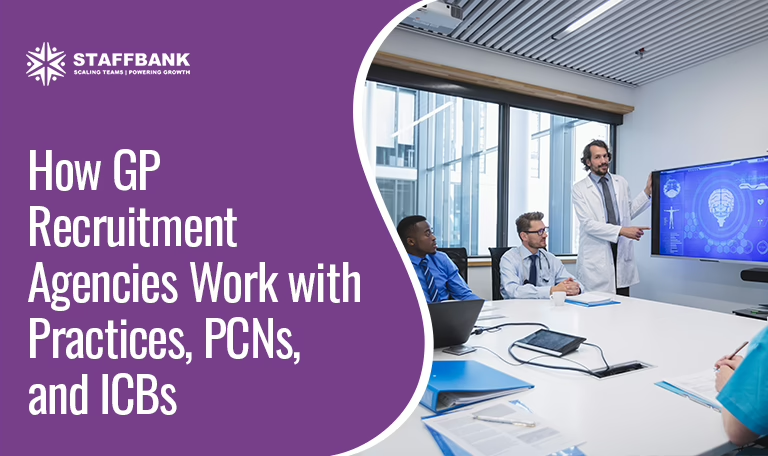
How GP Recruitment Agencies Work with Practices, PCNs, and ICBs
For most of the last decade, GP recruitment was something individual practices handled in-house. A vacancy would arise, a job listing would go up on NHS Jobs, and the process would unfold at its own pace. That model worked when GP numbers were stable. It no longer does.
The combination of an ageing GP workforce, rising patient demand, and increasing rates of early retirement has created consistent pressure across England, Scotland, Wales, and Northern Ireland. Practices are left managing rotas with gaps, relying on locum cover that wasn’t budgeted for, and spending significant time on recruitment processes that don’t always produce results.
This is where a GP recruitment agency becomes genuinely useful, not as a last resort, but as a structured, proactive partner. Rather than reacting to vacancies as they arise, an agency maintains an active pipeline of candidates: GPs returning from career breaks, newly qualified doctors seeking their first principal role, international medical graduates navigating UK registration, and experienced GPs open to a change of setting.
For a practice manager or GP partner dealing with this reality, engaging a specialist agency shifts the burden from reactive scrambling to structured search, with someone who already knows the market doing the groundwork.
What a GP Recruitment Agency Actually Does for an Individual Practice
At the practice level, the relationship with a GP recruitment agency is fairly direct. The agency takes on the search, screens candidates against the practice’s specific requirements, and manages the early stages of the process, so that by the time a candidate is presented to a partner or manager, the initial groundwork has already been done.
This typically covers three core areas:
- Candidate Sourcing: Active outreach to GPs not currently on the open market, including passive candidates who aren’t actively job-searching but may be open to the right opportunity.
- Compliance and Verification: GMC registration checks, appraisal and revalidation status, references, DBS, and right-to-work verification, all handled before a candidate reaches the practice.
- Role Matching: Understanding the culture, workload, and expectations of the practice to find GPs who will actually stay, not just fill a gap on paper.
What separates a strong agency from an average one is the quality of this matching process. A physician recruiter who understands UK primary care, the difference between a practice in a rural dispensing area and a large urban PCN hub, for example, will make fundamentally better placements than one working from a generic brief.
The best agencies also provide honest guidance on what a practice can realistically expect: how long a search is likely to take, what the going rate is for the type of role being offered, and whether the package being put forward is competitive in the current market. That kind of candid input is genuinely useful to a practice trying to make sensible workforce decisions.
How PCNs Are Using Recruitment Support Differently
Primary Care Networks present a different kind of challenge. PCNs are not single practices with a single vacancy, they are collections of practices with shared workforce needs, shared funding streams, and, increasingly, shared strategic goals around staffing.
For a Clinical Director or PCN manager thinking about workforce, the relevant question is not just “how do we fill this role?” but “what does our physician workforce look like in two years, and what are we doing now to shape that?” This is a planning challenge as much as a recruitment one, and it is where structured support from a physician recruitment firm can add real value.
PCNs typically face a distinct set of pressures: multiple practices with competing vacancy priorities, complexity around the Additional Roles Reimbursement Scheme, the need to balance salaried and portfolio GP models, and managing succession planning where older partners are approaching retirement. Retaining newly qualified GPs, who have multiple options and are often drawn to flexibility over traditional partnership, adds another layer of difficulty.
A physician staffing agency experienced in working at network level can help Clinical Directors think through not just who to hire, but how to structure the workforce across the network as a whole. This is particularly relevant around roles that sit across multiple practices rather than within a single one, portfolio GPs who split sessions between sites, for instance. Getting these placements right requires more than posting a job. It requires someone who understands how the network functions day to day.
The Strategic Dimension: Where ICBs Engage with Recruitment Partners
Integrated Care Boards are responsible for workforce planning across their entire geography, which means thinking about GP supply not just in one PCN or one locality, but across multiple systems simultaneously. At this level, physician recruitment outsourcing is less about individual placements and more about structured, scalable approaches to building GP supply across a region.
ICBs increasingly work with specialist recruitment partners to understand the physician workforce landscape across their area, where the shortfalls are most acute, which localities are at risk of practice closures due to vacancy pressures, and what targeted interventions could improve GP supply in underserved communities.
This kind of engagement with a physician recruitment firm goes beyond filling individual roles. It involves data-sharing, workforce modelling, and sometimes the development of regional GP recruitment campaigns, coordinated efforts to attract doctors to particular geographies through structured outreach, relocation support, and tailored package development.
At the ICB level, the relationship with a recruitment partner is inherently more strategic. The conversations are about pipelines, not individual hires. The agencies best placed to engage at this level are those with genuine market intelligence: real data on candidate movement, salary benchmarking, and the specific factors that drive GP retention in different types of communities. For ICBs, the value of a recruitment partner is not just in the placements they make, it is in the market insight they bring to workforce planning conversations.
What to Look For, and What to Avoid
Not all recruitment agencies operating in primary care have the same depth of knowledge or the same standards. For any organisation, whether a single practice or an ICB, the quality of the partnership matters enormously. A poorly matched placement costs far more than the agency fee; a vacancy that goes unfilled for six months carries its own significant cost in locum spend and lost clinical capacity.
When evaluating any recruitment agency, a few things are worth examining carefully. How deep is their existing candidate network in UK primary care specifically? Do they have consultants who understand the difference between different practice models, contract types, and workforce structures? Are they transparent about timelines and realistic about what the current market looks like?
It is also worth asking about their approach beyond placement. The best agencies maintain relationships with candidates after they are placed, which means they often have early visibility of retention risks and can raise concerns before a practice finds itself back to square one. This kind of ongoing partnership is very different from a transactional, fee-per-placement model.
For PCNs and ICBs considering more structured engagements, physician recruitment outsourcing, where an agency takes on a broader, ongoing recruitment function rather than responding to individual briefs, is increasingly common. This model works best when there is clear alignment on goals, transparent reporting, and regular review of what is and is not working.
GP Workforce Pressure Isn’t Going Away, But the Approach to It Can Improve
Whether you are a practice manager filling a single vacancy, a Clinical Director thinking about PCN-wide workforce strategy, or an ICB lead working on regional GP supply, the case for working with a knowledgeable, specialist recruitment partner has never been stronger.
The practices and systems that are managing best are those that treat recruitment not as a reactive task, but as an ongoing, structured part of how they operate. The GP workforce challenge is a long-term structural issue. The response to it needs to be equally considered.