How Healthcare Background Check Services Help Reduce Healthcare Hiring Delays
If you’ve ever sat in a hiring meeting watching a perfect candidate slip away because their start date kept getting pushed back, you already know the frustration. The interview went well. References checked out. The offer was accepted. And then… nothing happens for weeks.
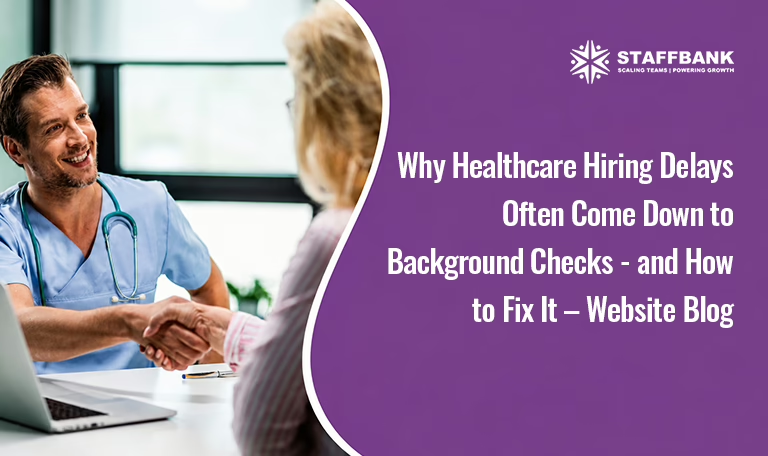
More often than not, the bottleneck isn’t the candidate, the hiring manager, or even the job market. It’s the background check process.
For healthcare organizations, this isn’t just an HR inconvenience – it’s a patient care issue. Every day a role sits unfilled because of a stalled verification is a day a unit runs short-staffed, a shift gets covered by overworked existing staff, or a service line operates below capacity.
Let’s look at why this happens so often, and what actually fixes it.
Why Healthcare Background Checks Take So Long
Healthcare hiring isn’t like hiring for most other industries. A standard employment background check might involve a criminal record search and an identity verification. Healthcare roles require significantly more – and each additional layer adds time if not managed properly.
Multiple verification sources: A single candidate might need primary source verification of their nursing license, checks against the OIG exclusion list, SAM.gov verification, state licensing board confirmation, DEA registration (for prescribing roles), education verification, and employment history spanning multiple states or even countries.
Manual processes create bottlenecks: Many organizations still rely on HR staff manually emailing licensing boards, waiting on fax responses (yes, still happening in 2026), and tracking verification status across spreadsheets. Each manual step is a potential delay point – and a potential point of human error.
Inconsistent vendor coordination: Some organizations use one vendor for criminal background checks, another for license verification, and handle drug screening separately. When these pieces don’t talk to each other, candidates fall through the cracks between systems.
Reactive rather than proactive screening: If background checks only start after an offer is accepted, you’ve already lost time. By the time results come back – sometimes 2-4 weeks later – candidates with other offers on the table may have already moved on.
The Real Cost of These Delays
It’s easy to think of a delayed background check as just “part of the process.” But the downstream effects are significant:
Lost candidates: In competitive markets for nurses, physicians, and allied health professionals, a two-week delay can mean losing a candidate to a competing offer.
Extended overtime and agency spend: Every day a position stays open, someone else is covering that shift – often at premium rates.
Compliance risk: Rushing or skipping verification steps to speed things up creates exposure to regulatory penalties, especially around exclusion list screening.
Damaged candidate experience: Long, opaque background check processes leave candidates wondering if something’s wrong, or whether the organization is disorganized – not a great first impression.
How to Fix It
The good news is that none of this is inevitable. Organizations that solve this problem well tend to take one (or more) of the following approaches.
1. Use Specialized Healthcare Background Check Services
General background check providers often don’t understand the nuances of healthcare credentialing. Dedicated healthcare background check services are built specifically around the verification requirements unique to this industry – license verification across all 50 states, exclusion list monitoring (OIG, SAM, state Medicaid exclusion lists), sanctions checks, and primary source verification that meets accreditation standards.
These services typically run checks in parallel rather than sequentially, use automated database queries instead of manual outreach where possible, and provide a single dashboard showing exactly where each candidate stands in the process – instead of HR chasing down five different vendors for status updates.
2. Start Screening Earlier in the Process
Rather than waiting until an offer is signed, many organizations now run preliminary screening – license verification and exclusion list checks in particular – earlier in the interview process, with full consent from the candidate. This means by the time an offer is extended, the time-consuming pieces are already done, and onboarding can move within days rather than weeks.
3. Consider Healthcare RPO as a Solution
For organizations facing chronic hiring delays – not just occasional bottlenecks – the issue often isn’t a single broken step. It’s that hiring as a whole hasn’t been built as a coordinated, end-to-end process.
This is where healthcare RPO (Recruitment Process Outsourcing) comes in. A healthcare RPO company doesn’t just source candidates – they own the entire hiring workflow, including background checks, credentialing, and compliance verification, as part of a single coordinated process.
Healthcare RPO services typically include:
- Sourcing and screening candidates against role requirements
- Initiating background checks and license verification early, in parallel with interviews
- Coordinating with compliance teams to flag any exclusion list or sanction issues immediately
- Managing the entire offer-to-start timeline as a single tracked process rather than handoffs between departments
Because a healthcare RPO company is measured on time-to-fill and quality of hire, they have a direct incentive to eliminate the kind of delays that plague internal HR teams juggling dozens of other responsibilities.
4. Partner with a Healthcare Staffing Agency for Flexible Roles
For temporary, travel, or per-diem positions, working with an experienced healthcare staffing agency or medical staffing agency can dramatically reduce the background check burden on your internal team. Reputable staffing agencies maintain pre-verified talent pools – nurses, allied health professionals, and physicians who have already completed license verification, background screening, and credentialing checks before they’re ever presented to a facility.
This means when you need coverage fast – whether it’s a single shift or a multi-month assignment – the candidate is essentially “pre-cleared” and can start as soon as facility-specific onboarding (like EMR training or unit orientation) is complete.
5. Build an Integrated Healthcare Staffing Solution, Not a Patchwork of Vendors
The organizations with the smoothest hiring processes tend to have one thing in common: they’ve stopped treating background checks, credentialing, sourcing, and onboarding as separate workstreams handled by separate vendors.
Instead, they’ve built (or partnered for) healthcare staffing solutions that integrate all of these pieces – permanent hiring, contingent staffing, background screening, and credentialing – under one coordinated approach. When everything is connected, a candidate’s verification status is visible to everyone who needs it, nothing gets duplicated, and nothing falls through the cracks between handoffs.
Bringing It All Together
Background checks aren’t going away – and they shouldn’t. Patient safety depends on thorough, accurate verification of every clinician’s credentials, license status, and history. The goal isn’t to cut corners. It’s to remove the friction, duplication, and manual bottlenecks that turn a necessary step into a weeks-long delay.
Whether that means investing in dedicated healthcare background check services that connect every piece of the process – the organizations that solve this well aren’t just filling roles faster. They’re protecting patient care, reducing burnout on existing staff, and building a reputation as an employer that respects candidates’ time.
If your hiring timelines keep slipping and background checks are consistently the reason why, it’s worth asking: is this a one-off problem, or a sign that your hiring process needs a fundamentally different structure?