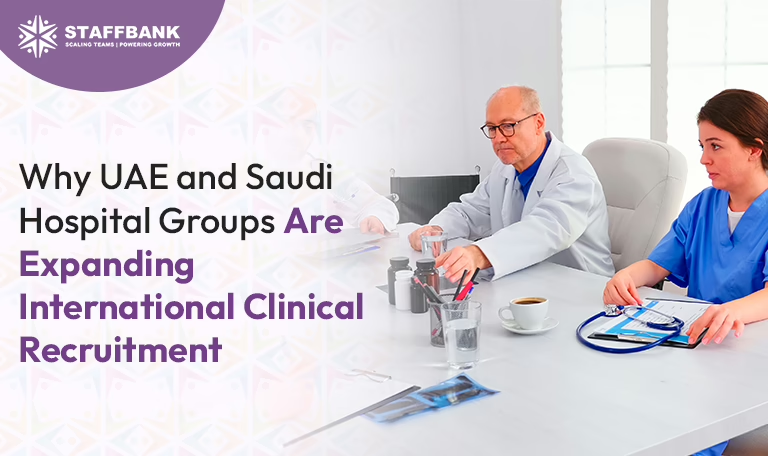
Why UAE and Saudi Hospital Groups Are Expanding International Clinical Recruitment
The Gulf’s healthcare sector is scaling faster than its domestic workforce can follow. Across the UAE and Saudi Arabia, hospital groups, health authorities, and private operators are opening new facilities, expanding bed capacity, and pursuing accreditation standards that require internationally qualified clinical staff at every level — from senior specialists to nursing and allied health.
For HR Directors and Workforce Directors in the region, the question is no longer whether to recruit internationally. It’s how to do it at the speed and scale the market now demands.
The workforce shortage is structural, not temporary
Vision 2030 in Saudi Arabia and the UAE’s continued investment in Dubai Health, Abu Dhabi’s SEHA network, and a fast-growing private hospital sector have created demand for clinicians that domestic training pipelines cannot fill on their own. This isn’t a short-term staffing gap driven by one bad hiring cycle — it’s a structural shortfall built into the pace of regional healthcare expansion itself. Facilities coming online in the next 24 months already assume a significant proportion of their clinical workforce will be sourced internationally.
Regulatory change is accelerating, not slowing, international hiring
DHA, HAAD/DOH, and the Saudi Commission for Health Specialties (SCFHS) have continued to refine licensing and credentialing pathways for internationally trained doctors, nurses, and allied health professionals. Far from creating friction, these frameworks are increasingly built with international recruitment in mind — recognising overseas qualifications, streamlining Prometric and Dataflow processes, and giving well-prepared candidates a clearer route to registration. Hospital groups that understand these pathways move faster than those treating each hire as a one-off compliance exercise.
Why traditional recruitment isn’t enough
Contingency recruitment — advertise, interview, place — was built for markets with a domestic talent surplus. The Gulf doesn’t have one. Hospital groups running contingency-only strategies are competing for the same narrow pool of candidates as every other operator in the region, driving up cost-per-hire and extending time-to-fill on exactly the roles that can least afford to sit vacant.
What’s needed instead is a pipeline: a continuous, pre-qualified flow of internationally sourced candidates matched against forecasted demand, not reactive vacancy-by-vacancy sourcing.
How international recruitment solves this — properly resourced
The hospital groups moving fastest are the ones treating international recruitment as workforce planning, not procurement. That means:
- Sourcing directly from source markets where clinical training standards align with UAE/Saudi requirements
- Managing licensing and credentialing in parallel with sourcing, not after an offer is made
- Building talent pools ahead of need, rather than starting the search when a role goes vacant
Why RPO is the more sustainable model
A Recruitment Process Outsourcing partnership embeds this entire pipeline into the hospital group’s own workforce strategy, rather than bolting on a series of one-off agency placements. The right RPO partner brings dedicated international sourcing capacity, licensing and credentialing expertise specific to Gulf regulatory frameworks, and continuity — the same team managing the pipeline month to month, not a rotating cast of contingency recruiters.
This is where specialist Healthcare Recruitment Outsourcing earns its margin over generalist providers: staying in a narrow lane of healthcare and clinical roles means faster candidate identification, fewer failed placements, and a sourcing network built specifically for the credentialing realities of Gulf healthcare — not adapted from a generalist template.
Staffbank Outsourcing Solutions partners with UAE and Saudi hospital groups to build sustainable international clinical workforce pipelines. If you’re planning expansion over the next 12–24 months, talk to our Gulf healthcare workforce team about what a dedicated RPO partnership could look like for your organisation.