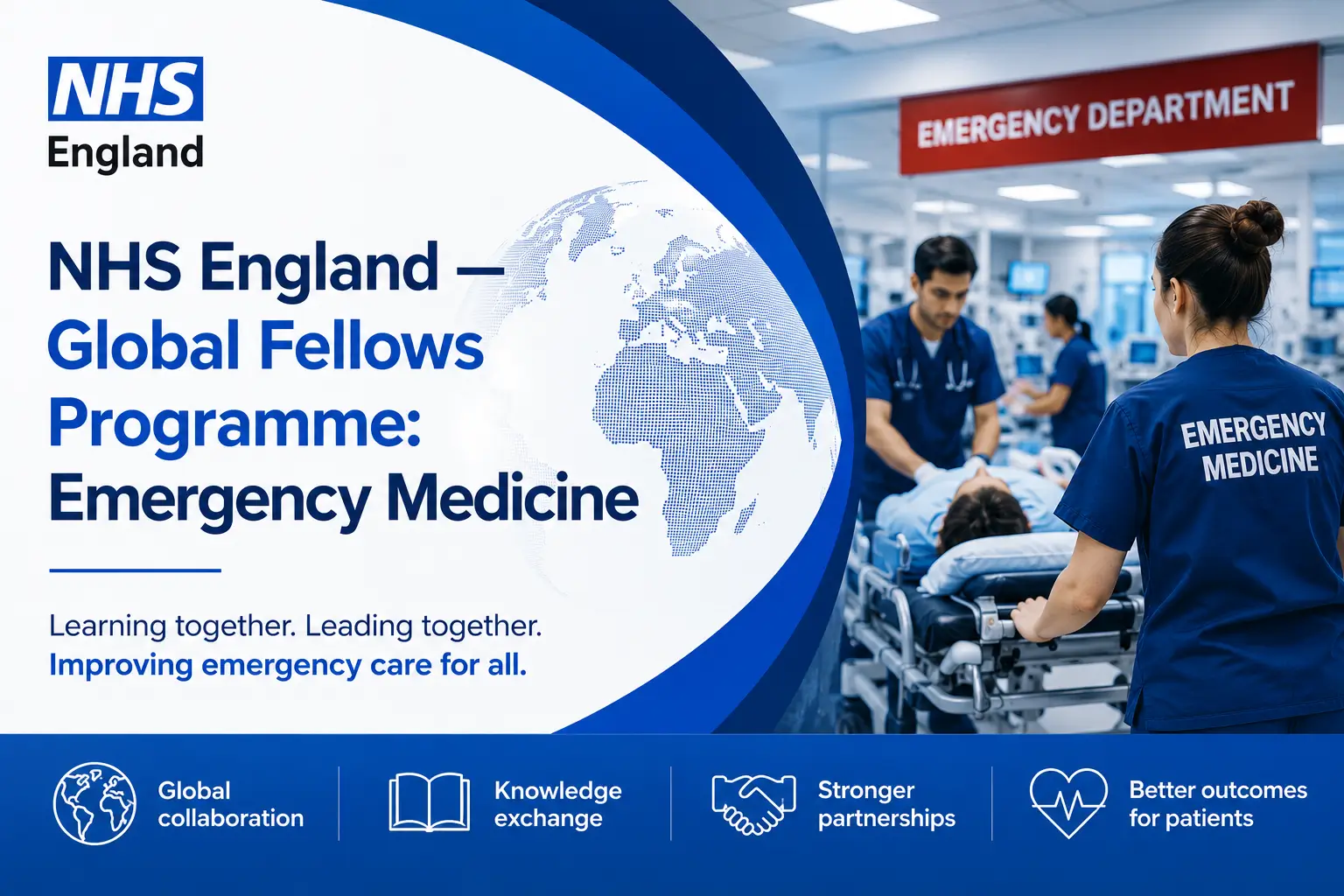
NHS England — Global Fellows Programme: Emergency Medicine
The Challenge
Emergency medicine is one of the most acutely pressured specialties in the NHS. Vacancy rates are high, domestic training pipelines are slow to respond, and the clinical and operational consequences of unfilled posts are immediate and measurable. International recruitment at consultant and registrar level is a structurally different exercise to nursing or allied health recruitment — the candidate pool is smaller, the regulatory pathway is more complex, and the institutional stakeholders involved are more numerous.
The Global Fellows Programme — Emergency Medicine was designed by NHS England to address this shortage through the structured recruitment of internationally trained emergency physicians at ST3 level and above. The programme operated across two distinct registration pathways, each with its own eligibility criteria, assessment requirements and GMC registration route. Delivering successfully across both simultaneously required a recruitment partner with specific knowledge of medical registration in the UK and a proven ability to navigate a stakeholder environment spanning NHS Trusts, the Royal College of Emergency Medicine (RCEM), the General Medical Council (GMC) and UK Visas and Immigration.
Our Role
Staffbank was engaged as a key delivery partner to the GFP-EM, responsible for the sourcing, assessment and end-to-end management of internationally trained emergency physicians across both programme pathways. Our scope encompassed:
- International physician sourcing and attraction — identifying and engaging qualified emergency medicine candidates at ST3 level and above across international markets
- Dual-pathway programme delivery across two distinct GMC registration routes:
- MTI Pathway — the Medical Training Initiative route, for candidates pursuing a fellowship-based training placement, requiring MRCEM Part 2 as the qualifying assessment standard
- Full Registration Pathway — for candidates seeking substantive GMC registration, requiring full MRCEM completion
- GMC registration management — coordinating the documentary, assessment and verification requirements of GMC registration for internationally trained physicians, including primary source verification, English language assessment and specialist qualification recognition
- Stakeholder coordination — working across NHS Trusts, the Royal College of Emergency Medicine (RCEM), the General Medical Council and UK Visas and Immigration to manage the multi-institutional requirements of each candidate’s pathway
- Visa and immigration coordination — managing Skilled Worker visa requirements for each cohort
- Onboarding and arrival support — ensuring candidates were supported through to verified commencement of clinical duties
All activity was conducted in adherence with the UK Code of Practice (CoP) for International Recruitment and the WHO Global Code of Practice on the International Recruitment of Health Personnel.
Dual-Pathway Delivery — The Operational Complexity
The GFP-EM presented a level of operational complexity that sets it apart from volume nursing or allied health programmes. Managing two concurrent registration pathways — each with distinct eligibility thresholds, examination requirements and GMC registration routes — within a single programme demanded a depth of regulatory knowledge and process discipline that generalist recruiters cannot provide.
The MTI Pathway operates under the Medical Training Initiative framework, which permits internationally trained doctors to undertake time-limited training placements in the NHS. Candidates on this pathway were required to demonstrate MRCEM Part 2 standard — a substantive clinical examination — before progressing. Managing candidate assessment preparation, examination timing and MTI sponsorship requirements simultaneously, across an international candidate pool, requires intimate familiarity with the MTI framework and its institutional gatekeepers.
The Full Registration Pathway required candidates to hold or be in a position to complete the full MRCEM — the Membership of the Royal College of Emergency Medicine — before substantive GMC registration could be achieved. This pathway involves a more extended timeline, more complex qualification mapping for overseas-trained physicians, and more touchpoints with the RCEM and GMC than the MTI route.
Staffbank managed both pathways concurrently — tracking individual candidates against pathway-specific milestones, coordinating with RCEM and GMC at each stage, and ensuring that pipeline integrity was maintained across a programme that, by design, had no single standardised route to completion.
Source Market Strategy
International emergency physician recruitment operates within a narrower permissible market than nursing or allied health, for two compounding reasons. First, the WHO Code constraints apply equally — active recruitment from countries experiencing critical medical workforce shortages is prohibited. Second, the MRCEM examination standard required by both pathways further filters the eligible international candidate pool to those whose training backgrounds produce graduates capable of meeting Royal College assessment standards.
Staffbank’s source market approach drew on operational experience across international physician recruitment in the GCC, South Asia, Southeast Asia, Africa and beyond — markets where emergency medicine training quality, GMC registration eligibility and MRCEM preparedness vary considerably and require granular rather than generalised assessment.
Candidate markets were evaluated against:
- WHO Code compliance — sourcing exclusively from non-designated shortage nations
- GMC registration eligibility — assessment of medical training frameworks against GMC primary medical qualification recognition
- MRCEM pathway viability — evaluation of training backgrounds against Part 2 and full MRCEM standard requirements
- English language baseline — targeting candidate populations with a realistic pathway to meeting GMC’s English language requirements
- Specialist depth — prioritising markets with sufficient emergency medicine specialist volume at ST3 and above to sustain programme delivery
Outcomes
Staffbank delivered more than 200 successful outcomes across the GFP-EM — internationally trained emergency physicians placed into NHS Trusts through both the MTI and full registration pathways.
In the words of the Programme Manager at NHS England’s Directorate of Global Health Partnerships:
“Global Career Networks Ltd (now Staffbank) is a key partner to the Global Fellows Programme Emergency Medicine (GFP-EM), sourcing and placing international emergency medicine doctors at ST3 level and above. Working with multiple stakeholders including various NHS Trusts, the Royal College of Emergency Medicine (RCEM), the General Medical Council and UK Visas and Immigration, GCN has demonstrated their ability to successfully navigate the often-complex requirements for internationally recruited staff to commence work in the UK. GCN has extensive exposure to international healthcare recruitment over the last twenty years and has contributed their insight to support the initiative and create successful outcomes in a challenging international market.”
— Jon James, Programme Manager, Directorate of Global Health Partnerships, NHS England
Why It Matters
Physician recruitment at specialty level is the most demanding end of international healthcare recruitment. The regulatory environment is more complex, the candidate pool is smaller, the stakeholder infrastructure is more extensive, and the margin for error — in candidate assessment, pathway management or GMC registration — is significantly lower than in allied health or nursing programmes.
Staffbank’s ability to deliver more than 200 successful outcomes across a dual-pathway emergency medicine programme, coordinating simultaneously with NHS Trusts, the RCEM, the GMC and UK Visas and Immigration, reflects a depth of operational capability that is rare at any scale. It is the product of a leadership team that has recruited physicians internationally for over three decades — across the UK, GCC, Australia, New Zealand, Singapore and Canada — and understands the regulatory, clinical and institutional landscape in which international physician recruitment operates.
For healthcare organisations facing emergency medicine vacancies that the domestic market cannot fill, the GFP-EM programme is evidence that international recruitment at specialty level can be delivered at scale, compliantly and to a clinical standard that meets NHS requirements. That evidence is not theoretical. It is a matter of record.
Credentials Relevant to This Programme
- Key delivery partner to NHS England’s Global Fellows Programme — Emergency Medicine
- Carter Wellington Global Recruitment Group (a Staffbank division) is an NHS framework-approved supplier
- Founding signatory to the WHO Global Code of Practice on the International Recruitment of Health Personnel
- Full compliance with the UK Code of Practice (CoP) for International Recruitment
- 30+ years of operational experience in international physician and healthcare workforce recruitment
- Direct working knowledge of GMC registration pathways for internationally trained physicians, including MTI framework delivery and MRCEM pathway management
- Established working relationships with the Royal College of Emergency Medicine, the General Medical Council and UK Visas and Immigration
Letter of recommendation held on file from Jon James, Programme Manager, Directorate of Global Health Partnerships, NHS England.
Ready to discuss your workforce requirements? Book a Workforce Planning Call →